





Imogen Calderwood
The Daily Mail
Reports emerged this week that the Taliban leader was killed in a dramatic internal shoot-out after a meeting of commanders of the now divided movement turned sour.
The formerly united group has been severed by a bitter internal turmoil that has seen a splinter cell break away and declare loyalty to ISIS, which is steadily carving a trail of bloody destruction through the Taliban’s Afghanistan territory.
It is believed that members of the ISIS-led breakaway cell could be responsible for the as yet unconfirmed death of the Taliban’s elected leader Mullah Akhtar Mansour.
His death, if proven, exposes the strife among the Taliban’s top ranks as the group seems to be crumbling under ISIS’ growing strength in Afghanistan.
ISIS would have good reason to want to take out the head of the Taliban group, weakening the group as it moves in on its Afghanistan territory.
ISIS’s regional affiliate, Wilayat Khurasan, has entrenched itself in the mountains of eastern Afghanistan and launched a violent campaign against local Afghans to crush any opposition.
Its fighters have defeated the local Taliban and have begun recruiting new members from 25 of Afghanistan’s 34 provinces.
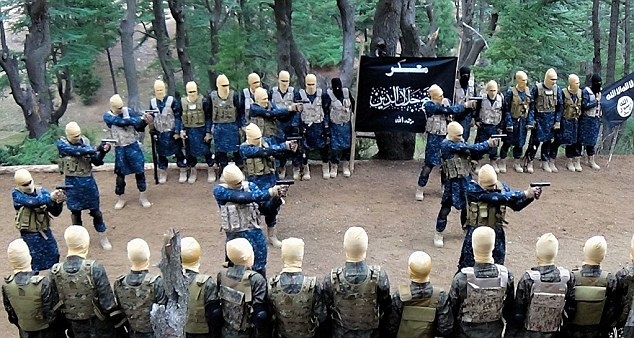
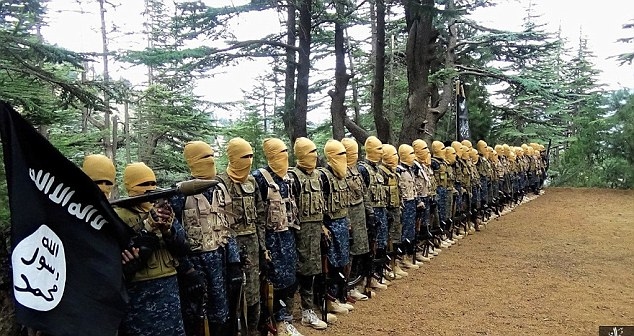
A series of shocking photographs have emerged from inside the ISIS training camps, hidden deep in the forests of the mountainous region.
Men wearing yellow balaclavas and clutching AK-47s sit in regimented rows in front of ISIS flags, while other images show the fighters learning how to use the weapons.
Although officials initially dismissed the threat that ISIS poses to the country, they have now been forced to sit up and take notice as its growth and wealth expands at an alarming rate.
A propaganda video released by Wilayat Khurasan shows 10 local men from the Shinwari tribe in Kot district, blindfolded and forced to kneel on a chain of explosives before being blown to pieces.
The graphic video, filmed from multiple angles, shows lingering images of the body parts remaining.
ISIS’s subtle invasion of Afghanistan began last autumn, although it took weeks for locals to realise who the foreigners were that were settling in their midst.
Before late July, the terror group had forced Taliban fighters out of the region and emerged from the mountain valleys of Peha and Mamond, attacking police and army units as they went.
At first, Wilayat Khurasan was seen more as a Taliban splinter group than an ISIS-led faction.
But a UN report released in September detailed ISIS’s expansive recruitment network in Afghanistan, via its local faction.
It claimed some 70 of ISIS's elite fighters had come from Iraq and Syria to drive the creation of the jihadists’ branch in the country.
Estimates now put the numbers of ISIS fighters in the four districts south of Jalalabad at somewhere between 1,200 and 1,600.
U.S. officials have also acknowledged the threat.
‘We used to call it nascent,’ said General John Campbell, commander of U.S.-led troops in Afghanistan, in July.
‘Now we say it is probably operationally emergent.’
The reported death of the Taliban’s elected leader in the country could prove to be one of the final nails in the group’s coffin, as ISIS moves to destroy the Taliban from the top down.
The alleged shooting comes just four months after Mansour’s election as leader, which sparked immediate splits in the group.
Some top leaders refused to pledge allegiance to Mansour, saying the process to select him was rushed and biased.
A breakaway faction of the Taliban led by Mullah Mohamed Rasool was formed last month, in the first formal split in the once-unified group.
The fault-line formed between those supporting renewed peace talks with Kabul in the 36-year-old conflict, and the groups allied to ISIS fighting to overthrow it.
Rasool’s deputy, Mallah Dadullah, was killed last month in a gunfight with Mansour loyalists, according to Afghan officials.
Now Rasool’s faction appears to have taken its revenge.
But the Taliban, which concealed the death of its previous leader, Mullah Omar, for two years, has insisted that Mansour is alive and well.
‘The sheer volume of rumours suggesting that something has happened to Mansour will pressure the Taliban to offer proof that he’s alive,’ a Western official in Kabul said.
‘Simply posting denials…won’t be considered credible enough, especially after Omar’s death was concealed for years.’